

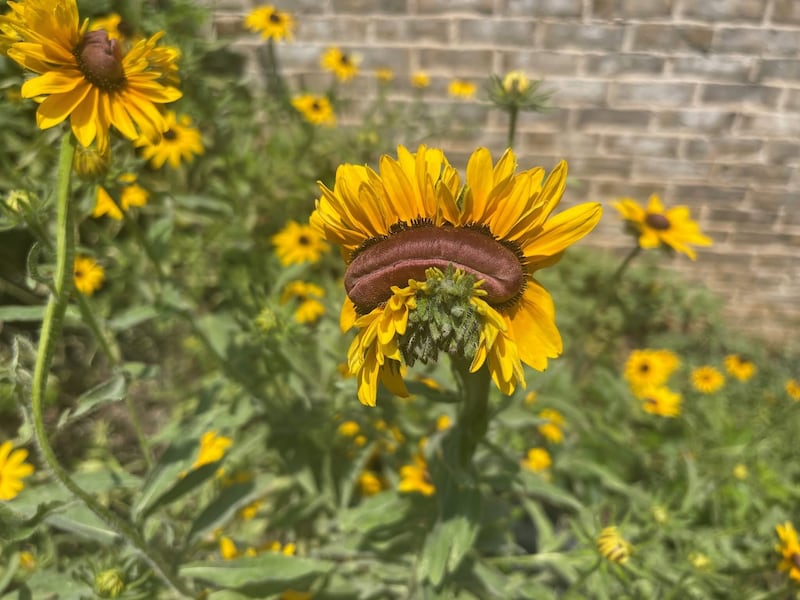
A: This appears to be coneflower (Echinacea), but nonetheless, what a weird phenomena. ‘Aster yellows’ is a disease caused by a small bacteria. It is commonly spread by leafhoppers, so it’s hard to stop.
This can happen on mums, coreopsis, delphinium, black-eyed Susan (Rudbeckia), and salvia.
Horticulturalist Bodie Pennisi at the University of Georgia tells me, “I’ve seen many coneflowers with that problem. It’s not curable. The syndrome manifests with fasciation, and loss of petal color and greening.” Remove the plants and discard them.
Fasciation is a condition causing plants to appear distorted, either as flattened, twisted, or enlarged stems or flower heads. It is sometimes due to bacteria, genetic mutations, or other environmental factors.
In the case of this brown-eyed Susan, it is not fatal. Just fascinating!
©2026 Cox Media Group