

The Pacific Ocean exerts a great deal of influence on weather and climate. But it is not the only ocean that does, nor are the oceans the only factors that impact climate and weather.
La Nina is not everything, it’s not the be-all and end-all of seasonal forecasting. Other factors play a role and sometimes take control unexpectedly.
We know the past doesn’t always predict the future, but we can use it as a guide.
As I’ve stated so many times before, no two La Ninas or El Ninos are ever exactly alike, although many are similar. The two El and La are together known as ENSO. El Nino Southern Oscillation.
Many long-range forecasters who do seasonal (3 months or more) and sub-seasonal outlooks (2-6 weeks) have observed many of the old connections and correlations have weakened or vanished over the last decade, so in the warmer background state of the 21st Century the old connections of the 20th Century no longer hold up, and we are yet to have enough time to discern the new decadal signals and how they are altered, there may be a new regime paradigm for ENSO.
So as a result, when the models detect and forecast a LA NINA they all default largely to what the average of past La Nina’s have produced in winter. You can see that in the model output for this coming winter below:

The 8 model composite mean for winter temperatures and precipitation:


But observation tells us there has been greater variance in what El Nino and La Nina (ENSO) produce in the winter in the recent decade, and we are seeing in real time the past two years and this year weather patterns that are at odds with La Nina behavior in the past. So caution is advised in just blind acceptance that this winter will be like most La Nina winters of old.
Even the 6 model blend shows an interesting January snow anomaly forecast. I don’t put much weight in it this far out but if the signal remains in the months ahead it will get my attention.

And another thing... the extreme distortion of current global sea-surface temperatures is unlike anything we’ve seen before in history, making it a wild card for predicting the season ahead, because it has no past close match globally (yellow is warmer than normal, red shades are way above-normal):

Just to offer one example. CSU hurricane researcher noted that ...

Maybe it doesn’t mean anything or maybe it does, but just for reference (not a forecast) here is the average winter temps from those years:

Not like most La Nina’s at all.
Also, research by WeatherBell and others have observed ocean warm pools in certain regions can telegraph winter temp means IF they continue in the months ahead, these are called teleconnections:

HERE ARE THE RESULTS (FOR NOW) OF MY BEST NON-WEIGHTED ANALOGS FOR THIS COMING WINTER:


WEIGHTED ANALOGS FOR AVERAGE WINTER 2022-23 TEMPS AND PRECIPITATION:


WEIGHTED ANALOG AVERAGE TEMPS for the period of NOVEMBER-MARCH:
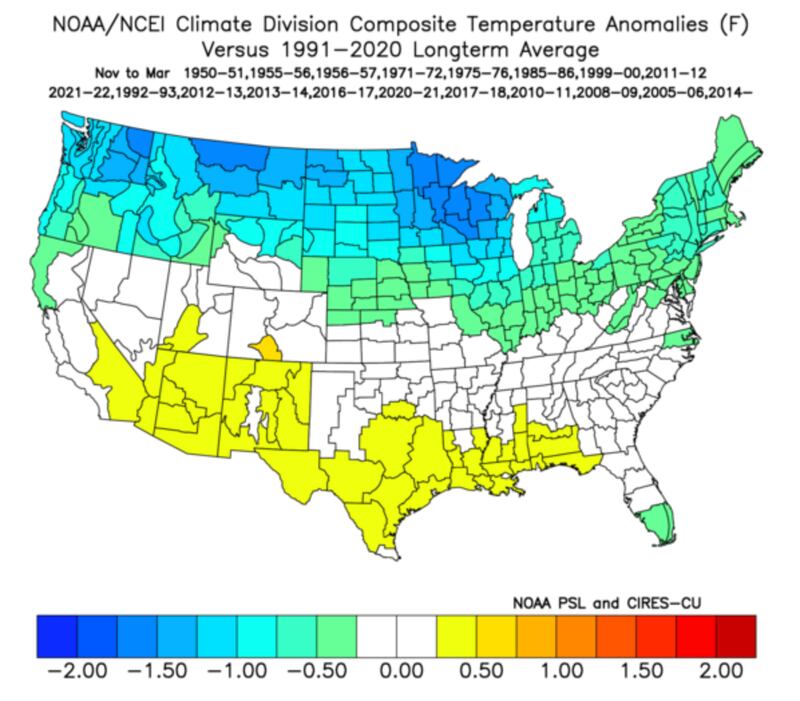
So thus far the analog years composite differs from the canonical La Nina a fair bit.
Either way, La Nina winters have a higher tendency toward variability and volatility over the November to March period:

My official winter outlook will be issued by Thanksgiving.
For more frequent weather commentary follow me on Twitter @MellishMeterWSB.
©2022 Cox Media Group