


Mortgage rates are shaping how homeowners think about their homes, from whether they can afford to move to whether they can afford to maintain the homes they already own. For many homeowners, selling would mean giving up a favorable mortgage rate and taking on a higher one, while rising household expenses and repair costs are putting additional pressure on their budgets.
Splitero surveyed 2,713 U.S. homeowners to examine how rising mortgage rates and housing costs are shaping their decisions about moving, maintaining their homes, and accessing home equity.
55% of homeowners say housing costs are harder to keep up with than when they bought
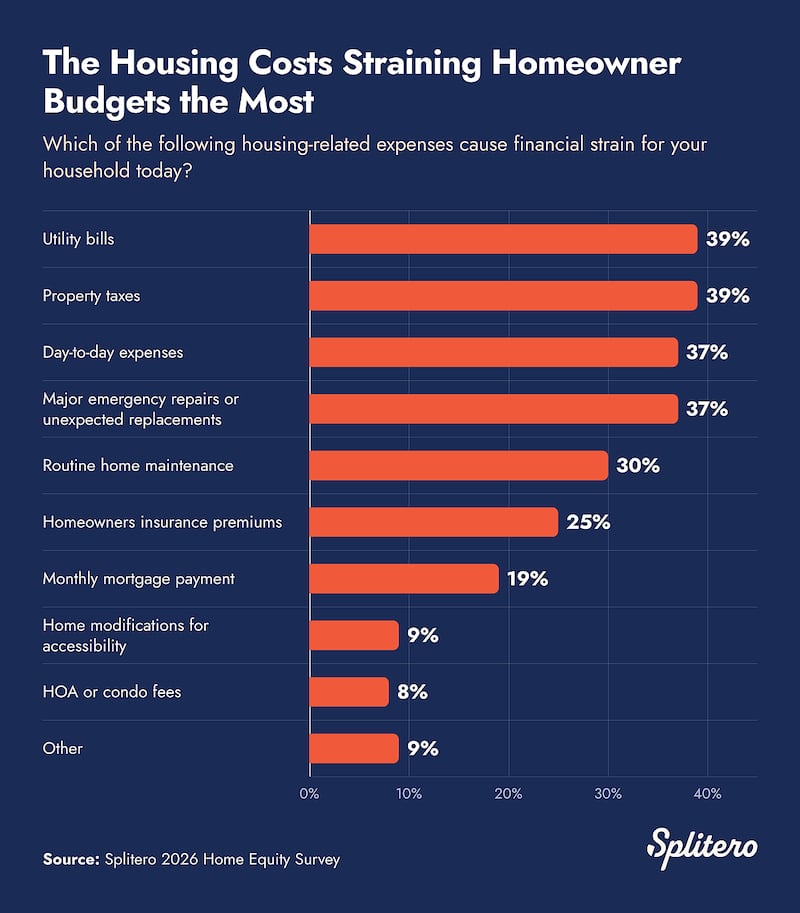
Mortgage payments are only one part of the cost of owning a home. Utilities, property taxes, insurance, maintenance, and unexpected repairs can all put pressure on a household budget.
Keeping up with these additional costs has become more difficult for many homeowners over the years: 55% of homeowners reported that keeping up with housing costs is harder today than when they bought their homes. Utilities and property taxes were each identified by 39% of homeowners as expenses causing financial strain, compared with 19% who pointed to their mortgage payment.
Splitero
These pressures are prompting homeowners to make trade-offs. Among homeowners who took at least one step in the past year to keep up with rising housing costs, 42% cut back on daily essentials, 37% delayed necessary maintenance, and 33% drew from savings.

Splitero
For some homeowners, the strain raises concerns about whether they can afford to stay. Thirty-six percent worry that rising property taxes, insurance premiums, or homeowners association fees could eventually force them to sell. Unexpected repair costs can add to that pressure. Only 39% said they could cover an urgent $5,000 home repair with cash, while 21% would use a credit card.
37% of homeowners are staying put to avoid a higher mortgage rate
For homeowners who secured a low mortgage rate in previous years, moving can mean taking on a substantially higher monthly payment. According to Realtor.com, 78% of outstanding mortgages had interest rates below 6% in the first quarter of 2026. Meanwhile, based on Freddie Mac's Primary Mortgage Market Survey, the average rate for a 30-year fixed mortgage reached 7.4% as of October 8, 2026.
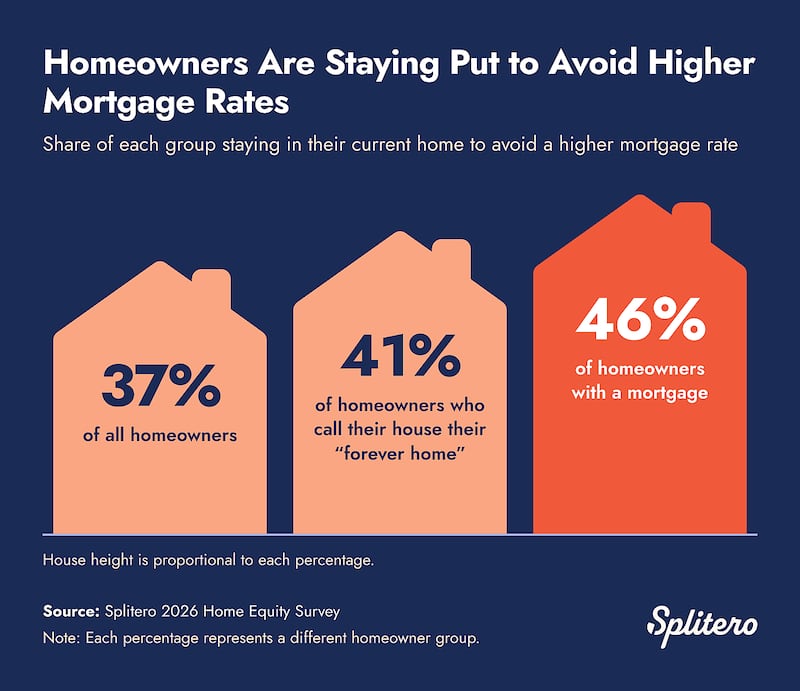
Splitero’s survey found that 37% of homeowners are staying in their current homes to avoid a higher mortgage rate, rising to 46% among homeowners with a mortgage.
High mortgage rates may be doing more than delaying homeowners’ next move; they could be changing where they see themselves living for the long term. Fifty-five percent of homeowners call their current house their “forever home,” and 41% of that group say they are staying to avoid a higher rate.
Splitero
This reluctance to give up a favorable mortgage is known as the mortgage rate lock-in effect. According to Freddie Mac's research, the average lock-in effect was worth an estimated $55,000 per household in June 2023, based on fixed-rate loans in Freddie Mac's portfolio.
Staying put, however, doesn’t mean homeowners can put off every expense. As housing costs rise and homes require upkeep, remaining in place can bring its own financial challenges.
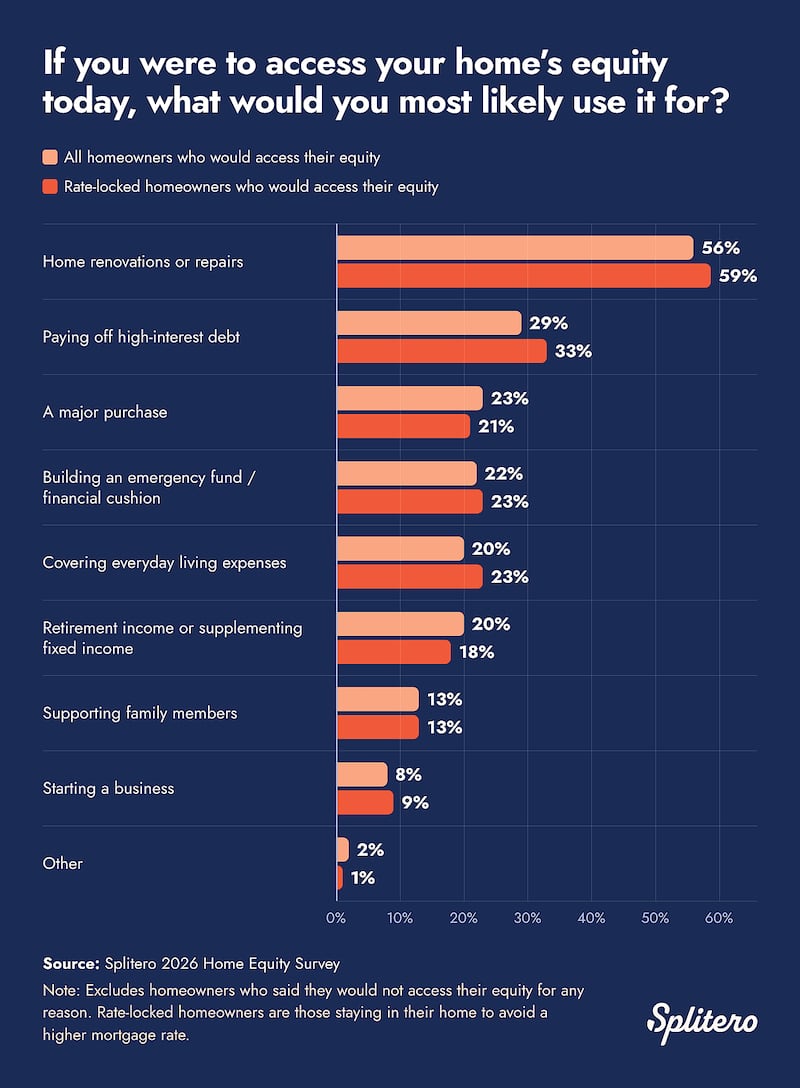
52% of rate-locked homeowners would put their equity into renovations or repairs
More than half (52%) of rate-locked homeowners would use their home equity for renovations or repairs, compared with 44% of homeowners overall.
Splitero
Maintenance is another pressure point. Thirty-two percent of homeowners staying put to avoid a higher rate had delayed necessary maintenance in the past year to keep up with rising housing costs. That compares with 26% of homeowners looking to move or refinance, 25% who said rates were a minor factor, and 19% whose decisions were unaffected by rates.
Unexpected costs add to that pressure. Sixty-three percent of homeowners staying put to avoid a higher rate said unexpected maintenance costs worried them more than day-to-day expenses, compared with 44% of homeowners whose decisions were unaffected by rates.
41% of homeowners think every way to tap equity comes with a monthly payment
The pressure further extends to homeowners’ ability to take on new financial commitments. Forty-two percent said their household couldn’t afford another monthly payment right now, potentially limiting the options they feel comfortable considering.
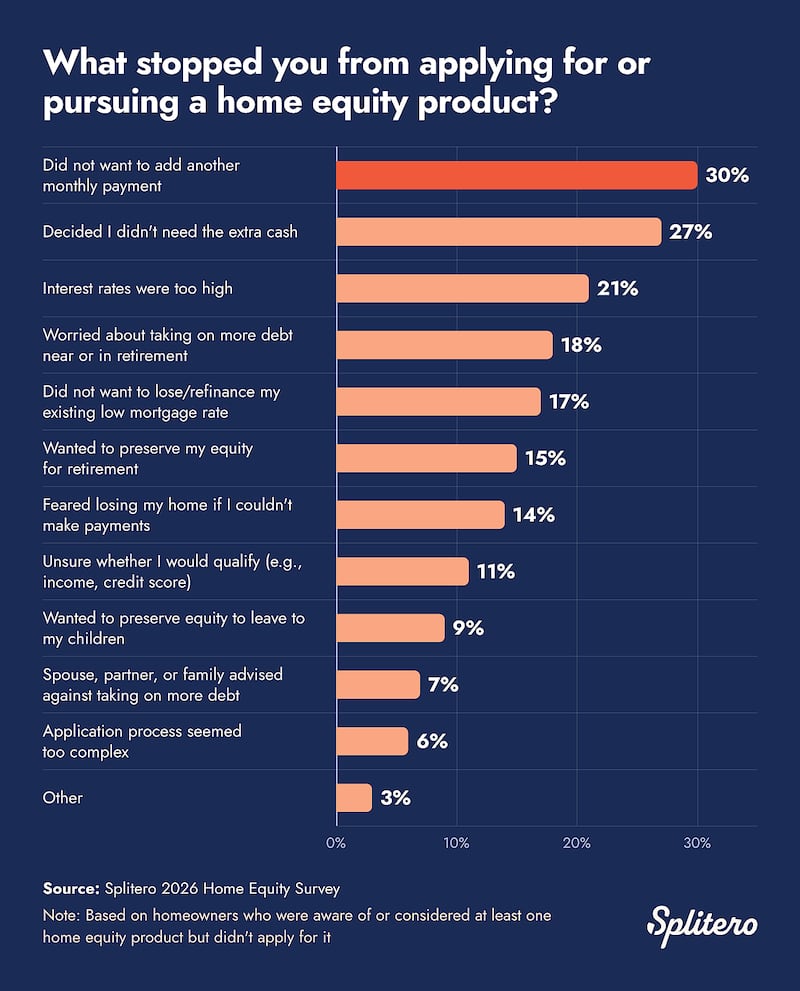
For homeowners already struggling to keep up with housing costs, taking on another monthly payment can make accessing home equity feel out of reach. Forty-one percent of homeowners believe every way to access home equity requires a new monthly payment. Among homeowners who knew about or had considered a home equity product but didn’t apply, the largest number of respondents, 30%, said they didn’t want another monthly payment.
Splitero
Home equity loans, HELOCs, and cash-out refinances involve borrowing and repayment obligations. A home equity investment (HEI), by contrast, provides funds in exchange for an agreed-upon share of a home's future value.
Fifty-three percent of homeowners said they’d be more open to accessing their equity if it didn’t require a new monthly payment. Still, no monthly payments doesn’t mean no cost. Homeowners should understand the fees, settlement terms, and potential future cost before choosing an option.
For homeowners looking to maintain the homes they’re staying in without giving up a low mortgage rate, an HEI may be worth exploring alongside other options. Understanding the agreement’s terms, including fees and how the investment must be settled, can help homeowners decide whether it fits their needs.
Methodology
This survey was commissioned by Splitero through PureSpectrum. All figures, unless otherwise stated, are from this survey. The sample consists of 2,713 U.S. adults ages 35 to 85 who own their primary residence. Fieldwork was undertaken between Sept. 16 and 23, 2026. The survey was carried out online using a non-probability sample, with quotas to align the sample with the age distribution of U.S. homeowners and an even gender split. Some findings are based on subsets of respondents, noted where relevant. Percentages are rounded to the nearest whole number and may not sum to 100% due to rounding.
This story was produced by Splitero and reviewed and distributed by Stacker.