


Many people in the U.S. believe airplane etiquette has gone downhill, and they mostly blame fellow passengers for the drop in civility. It's just one of the fascinating findings from a new survey by YouGov, commissioned by The Points Guy, on everything travel.
If you've paid any attention to social media, you know passenger plane etiquette is a hot topic. Debates rage about who should get the armrest, whether you should recline your seat, whether people are allowed to go without shoes on the aircraft, and who controls the window shade.
Passenger shaming is a real thing on social media, too. Have you ever seen a photo of someone's bare feet on a bulkhead seat?
TPG commissioned a nationally representative survey of more than 2,500 U.S. adults from July 29-31 to find out where the public stands on some of the biggest etiquette questions about flying.
As it turns out, many people think passenger behavior is getting worse, but most don't blame the airlines — they blame other passengers instead.
Here are some of the other most interesting findings:
- Noise is most annoying: More Americans (27%) say loud conversations or passengers playing music and videos without headphones is the most annoying in-flight behavior.
- 40% of people say airlines should ban phone or video calls during flights, versus 33% who say airlines should not.
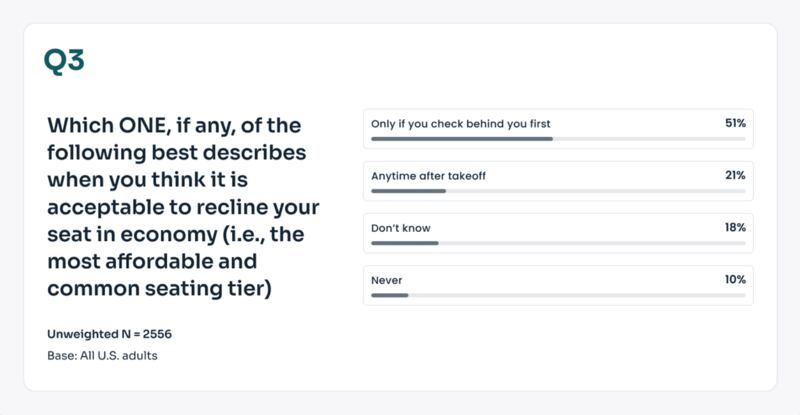
- A majority (51%) say it is acceptable to recline your seat in economy only if you check behind you first.
- Americans do not agree with the rule that the middle-seat passenger gets the armrests, as only 11% say the middle-seat passenger should get both armrests.
- Orderly deplaning: Nearly two-thirds (65%) say leaving the aircraft row by row from front to back is the proper way to exit an airplane.
- 42% of people say passenger behavior has gotten worse over the past five years.
- 44% of people say seat-swap requests aren't considered rude.
After analyzing the data, one takeaway is that Americans generally don't want more rules; they want more courtesy.
What's most annoying on a plane? Noise is public enemy No. 1
If you are most annoyed by people talking loudly or blasting videos without headphones, you are not alone. A whopping 27% of Americans said that noise is the most annoying passenger behavior on planes.

YouGov, The Points Guy
Passengers reclining their seats too far back without warning was a close second, with 21% citing it as the most annoying passenger behavior. Another 8% of those polled said people taking their shoes off or going barefoot on board is the most annoying. Meanwhile, 12% said they don't get annoyed by any passengers' behavior.
Though noise was cited as the biggest passenger annoyance, interestingly, there is no strong majority of Americans who think phone or video calls should be banned on planes.
Per the survey, 40% think airlines should not ban phone or video calls during flights, while 33% think they should. However, 27% are still undecided on the issue.
Still, it's clear that the biggest etiquette offense isn't taking up space — it's taking over the cabin with noise.
What about seat recline?
The debate over reclining seats never seems to go away.
Should you never recline? Always recline? Is it your seat, so you can do whatever you want? TPG’s survey suggests most Americans land somewhere in the middle.
The survey found that Americans say you can recline your seat in most instances, just be considerate. Courtesy wins the reclining debate in the economy cabin.
A small majority (51%) say it's acceptable to recline in economy only if you check behind you first. Just 21% say it's fine to recline anytime after takeoff, while only 10% say passengers should never recline.
YouGov, The Points Guy
That's a pretty clear message. Most travelers aren't opposed to reclining, but they are opposed to surprising the person behind them. Common courtesy wins here, too.
Who should get the armrests?
The survey suggests that most Americans don’t agree that the middle-seat passenger should get both armrests, as only 11% said they should automatically.

YouGov, The Points Guy
Instead, nearly twice as many (20%) said the middle passenger should get priority, but everyone should share. The largest group (31%) said everyone should simply share the armrests equally.
Perhaps the biggest surprise came from the fact that more than a quarter (26%) weren't even sure what the etiquette should be.
That suggests one of the travel world's most repeated "rules" may not be nearly as universally accepted as many frequent flyers assume.
Seat swapping
Have you had a passenger approach you and ask you to trade seats?
Americans appear to be relatively open to the request: 44% of respondents said it is not rude to ask another passenger to swap seats after boarding, compared with 34% who said it is rude. Another 22% weren't sure.

YouGov, The Points Guy
Of course, no matter what the opinions on it are, the best rule of thumb might be that it's OK to ask, but don't expect another passenger to give up their seat.
Additionally, some airlines charge a fee to choose a seat, so a passenger may be less inclined to swap if they paid for that specific seat.
What's appropriate attire on the plane?
People don't seem to mind passengers dressing less than business casual on the plane. Americans definitely don't believe you need to wear a suit to fly, but overwhelmingly prioritize comfort.
A combined 72% of people said the most appropriate attire on a flight is either simply wearing whatever is comfortable (38%) or wearing casual athletic and loungewear, such as leggings, sweatpants and T-shirts (34%).

YouGov, The Points Guy
Just 1% believe pajamas are the most appropriate airplane attire, and another 1% favored revealing clothing.
Wait for your turn to deboard
If there was one issue Americans agreed on more than any other, it was waiting your turn to get off the plane. Orderly deplaning has overwhelming support.
Nearly two-thirds (65%) believe that passengers should leave row by row, from the front to the back of the aircraft.

YouGov, The Points Guy
Only 10% said it's proper to move ahead whenever there's an opening, while 9% said cutting ahead is appropriate if you're trying to make a tight connection.
Who gets the window shade?
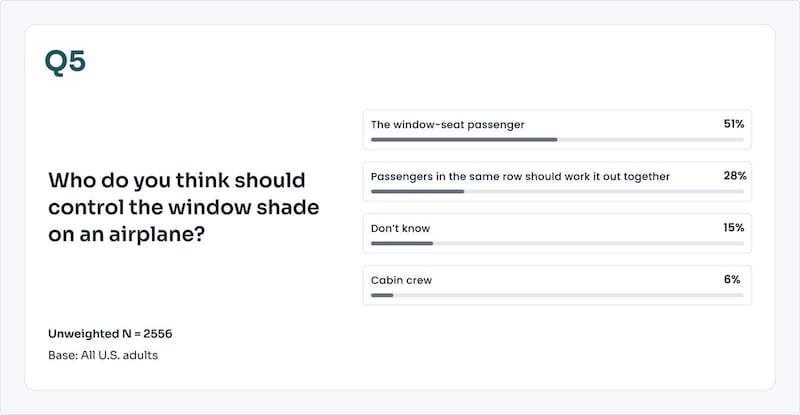
Who gets to control the window shade is another debate that seems to divide cabins. The survey found that the window-seat passenger usually wins the shade debate.
A slim majority (51%) said the passenger sitting in the window seat should control the shade.
YouGov, The Points Guy
Still, more than 1 in 4 (28%) think everyone in the row should work it out together.
Americans think plane etiquette has gotten worse
Forty-two percent of Americans said airline passenger etiquette has worsened over the past five years (either a lot or somewhat), while just 10% believe it has improved.

YouGov, The Points Guy
However, per TPG’s survey, the majority don't blame airlines for the decline in plane etiquette over the last five years.
When asked who's most responsible for poor behavior on airplanes, a majority (52%) pointed squarely at passengers themselves.

YouGov, The Points Guy
Only 8% blamed airlines and their policies, while another 8% blamed social media and influencers.
Bottom line
Despite the viral videos you've seen of “bad” passenger behavior, Americans seem to agree more than they disagree on what constitutes appropriate airline behavior.
The data suggests that Americans aren't necessarily looking for more rules, but they're looking for common courtesy.
Use headphones, check before reclining, don't cut in front of others during deplaning, dress comfortably but not inappropriately and communicate with fellow passengers.
Remember, passengers on a plane are all packed together, paying too much for too little, and maybe even a little stressed while flying.
Common courtesy can go a long way toward improving the overall flight experience.
This story was produced by The Points Guy and reviewed and distributed by Stacker.